
Quantum Computing Weekly Round-Up: November 29, 2025
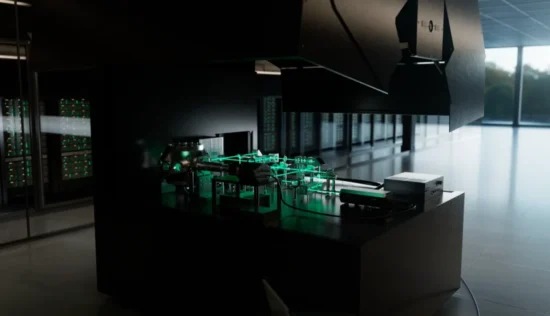
Above: Pasqal’s QPU. Courtesy Pasqal.
Quantum Computing Weekly Round-Up just dropped and holy qubits—this week the entire ecosystem hit escape velocity. Sovereign funds wrote nine-figure checks, the Middle East flipped on its first 200-qubit beast, drones started thinking with trapped ions, and governments literally made post-quantum crypto mandatory. Sit this one out and your 2026 roadmap becomes someone else’s victory lap.
Money Tsunami
London-based Firgun Ventures detonated a $250 million quantum-dedicated fund targeting early-growth startups in computing, sensing, and post-quantum crypto, locking in an immediate $70 million from the Qatar Investment Authority plus Quantinuum founder Ilyas Khan—proof sovereign wealth is betting billions on qubits. D-Wave forced redemption of every public warrant and bagged $54.6 million in fresh cash at $11.50 each, turbocharging their annealing machines that already solve logistics problems in sub-seconds for customers like Volkswagen and Lockheed. Bain’s blockbuster report calls quantum “inevitable”, projecting $100–250 billion in annual value by 2035 across pharma, finance, and materials—starting with the companies that raise and deploy capital right now.
Hardware That Ships
Pasqal and Aramco officially commissioned Saudi Arabia’s first full-scale quantum computer, a 200-qubit neutral-atom processor now running live energy-optimization workloads inside Aramco’s Dhahran research hub. IonQ inked a deal with Korea’s Heven AeroTech to embed trapped-ion quantum networks into heavy-lift hydrogen drones, enabling GPS-denied swarm routing and real-time sensor fusion backed by $100 million in U.S. Air Force contracts. Heriot-Watt University stunned everyone by building an eight-user quantum network using nothing more than £100 off-the-shelf telecom fiber, teleporting entanglement across wavelength channels—massive proof that metropolitan-scale quantum internets are cheaper than anyone thought. Meanwhile Sparrow Quantum’s QTRAIN consortium, armed with €15 million from the EU, is sprinting to deliver the world’s first commercially available quantum transceiver by 2027, promising 60 % lower power and half the footprint of today’s lab rigs.
Policy Hammer
President Trump’s Genesis Mission executive order just flung open the DOE’s $1.7 trillion national-lab treasure chest to Quantinuum, IBM, Google, Microsoft, and Nvidia—pure-play publics notably left outside the velvet rope. The UAE passed sweeping post-quantum encryption regulations requiring every government entity to publish migration roadmaps by mid-2026 under the Cybersecurity Council’s authority. Forbes insiders say new U.S. executive orders landing imminently will mandate PQC deployment across federal agencies and critical infrastructure contractors in record time, tying quantum readiness to AI governance in one unbreakable knot.
Crypto Armor Drops
SEALSQ began volume shipments of the QS7001 secure element, the first RISC-V chip with hardware-rooted Kyber and Dilithium that achieves full CNSA 2.0 compliance the moment you solder it—perfect for cold wallets, smart meters, and defense gear. McKinsey’s new banking report reveals live QKD pilots at HSBC, Danske Bank, and others, forecasting $400–600 billion in unlocked value once hybrid quantum-classical risk models go mainstream. Bankless analyst David Hoffman argues Ethereum is structurally quantum-resilient thanks to stealth addresses and upcoming Verkle trees, potentially flipping Bitcoin’s narrative if Shor-class machines ever materialize.
Open-Source Rocket Fuel
Open-source frameworks like Qiskit, Cirq, and PennyLane are explosively accelerating quantum machine learning, letting startups in India and Europe train fraud detectors and protein folders without owning a single qubit. AWS turned re:Invent 2025 into a full-blown hybrid quantum festival, showcasing Braket + Fire Opal pipelines that let you offload variational workloads to real IonQ and Rigetti hardware from inside your existing GPU clusters—today, not 2030.
Science That Breaks Physics
Princeton researchers paired nitrogen-vacancy defects in diamond to achieve 40× higher sensitivity, peering into nanoscale noise that could finally explain high-temperature superconductors. University of Tokyo unveiled a hybrid fault-tolerant protocol that slashes physical qubit overhead by orders of magnitude while preserving clock speed—direct rocket fuel for logical qubit scaling. Kyoto University discovered the long-hunted nodal metal phase in triple-layer cuprates, clarifying why these materials superconduct at record temperatures and lighting a clearer path to room-temperature power grids.
Global Collab Sprints
Alice & Bob rocketed onto Sifted’s Future 50 as Europe’s sole pure-play quantum company, riding cat qubits and a 417 % CAGR. SEALSQ and Quobly are fusing hardware PQC into CMOS-compatible spin qubits for natively quantum-safe processors. Pasqal locked a four-year, 10,000-qubit roadmap with CNRS inside the new AtomIQ-Lab at Paris-Saclay.
Bottom Line!
This week, quantum went from “interesting research” to “deployed, funded, and legally mandated”—2025 just carved the starting line in diamond.
—
See the full week of articles in the Weekly Archives Pages found at The Qubit Report. Also from The Qubit Report archives is the full, final page of The Qubit Report from this week and the Weekly Round-Up from last week, November 22, 2025.