Quantum Computing Weekly Round-Up: Week Ending March 21, 2026
Week Ending March 21, 2026. What a blockbuster week for quantum tech — UK’s £2B push and first 100-qubit delivery, multiple Nasdaq moves and fundraises,

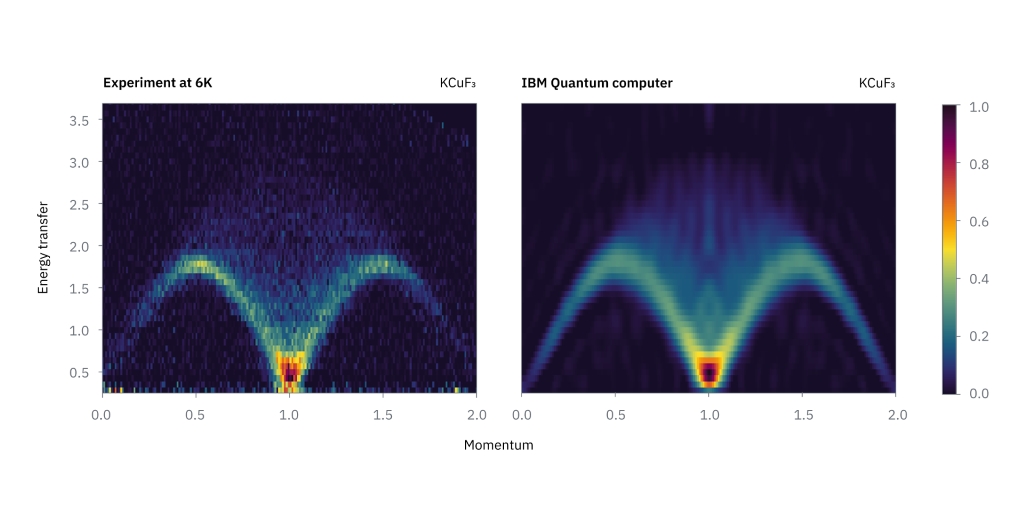
Above: IBM’s quantum simulation. Courtesy IBM.
Key Takeaways
Scientists reached a key milestone in quantum computing on March 26, 2026. IBM announced its quantum processor accurately simulated properties of real magnetic materials. The results matched data from neutron scattering experiments at national laboratories. This work shows quantum computers can now handle complex material simulations that classical methods often struggle to predict.
Researchers from the U.S. Department of Energy-funded Quantum Science Center led the effort. Teams from Oak Ridge National Laboratory, Purdue University, University of Illinois Urbana-Champaign, Los Alamos National Laboratory, University of Tennessee, and IBM took part. They focused on the magnetic crystal KCuF3. The material serves as a well-known test case for quantum behaviors in one-dimensional systems.

Neutron sources help scientists study quantum properties inside materials. Neutrons exchange energy and momentum with spins in the sample. In this study, the team compared real neutron scattering measurements of KCuF3 with quantum computer simulations. The match proved strong. Allen Scheie, a condensed matter physicist at Los Alamos National Laboratory, noted the quality of the results. He said, “This is the most impressive match I’ve seen between experimental data and qubit simulation, and it definitely raises the bar for what can be expected from quantum computers.”
Arnab Banerjee, assistant professor of Physics and Astronomy at Purdue University, shared his excitement too. He explained, “There is so much neutron scattering data on magnetic materials that we don’t fully understand because of the limitations of approximate classical methods. Using a quantum computer for better understanding these simulations and comparing experimental data has been a decade-long dream of mine, and I’m thrilled that we have now demonstrated for the first time that we can do that.”
Improvements in hardware made this possible. Lower two-qubit error rates on IBM processors helped boost accuracy. Quantum-centric supercomputing workflows combined quantum and classical resources effectively. Travis Humble, director of the Quantum Science Center at Oak Ridge National Lab, highlighted the broader value. He stated, “Quantum simulations of realistic models for materials and their experimental characterization is a major demonstration of the impact quantum computing can have on scientific discovery workflows.”
There is so much neutron scattering data on magnetic materials that we don't fully understand because of the limitations of approximate classical methods.
— Arnab Banerjee, Assistant Professor of Physics and Astronomy, Purdue University
The researchers used a superconducting quantum processor with up to 50 qubits. They computed spatiotemporal correlation functions and reconstructed the dynamical structure factor. This allowed direct comparison with inelastic neutron-scattering data. Abhinav Kandala, principal research scientist at IBM, pointed to future gains. He said, “These results were really enabled by the two-qubit error rates that we can now access on our quantum processors. We expect further improvements in error rates and extensions to higher dimensions to enable predictions of material properties that are challenging for classical methods alone.”
Moreover, the team moved beyond KCuF3. They applied the method to material classes with more complex interactions. This step shows the approach can scale. Quantum computers now act as reliable tools for materials science. Scientists can explore behaviors in superconductors, batteries, and drugs more deeply.
These results were really enabled by the two-qubit error rates that we can now access on our quantum processors.
— Abhinav Kandala, Principal Research Scientist, IBM
Understanding quantum behavior drives new material design. Classical computers often rely on approximations for these systems. Quantum processors, however, model interactions more directly. Consequently, researchers gain better insights into real-world properties. For example, accurate simulations could speed up work on efficient energy storage or advanced medical compounds.
This result fits into larger IBM efforts. Recent projects include quantum simulation of a half-Möbius molecule and large-scale protein modeling with Cleveland Clinic. Together, these advances build quantum-centric supercomputing as a practical scientific instrument.
Continued hardware gains and algorithm refinements will expand capabilities. Teams plan to tackle higher dimensions and more challenging materials. In the end, quantum tools may help predict properties that classical methods cannot handle well. Scientists and industries stand to benefit across energy, medicine, and beyond.
Researchers invite further collaboration to test these methods on new systems.

Week Ending March 21, 2026. What a blockbuster week for quantum tech — UK’s £2B push and first 100-qubit delivery, multiple Nasdaq moves and fundraises,


Quantum Machines today, unveiled The Open Acceleration Stack, a modular framework for hybrid quantum-classical systems. It supports ultra-low latency links via NVIDIA NVQLink and OPNIC.

This quantum computing weekly round-up captures explosive progress across funding, hardware, security, and international developments. Key highlights include U.S. Department of Energy’s $37 million push