

SOFTWARE & ALGORITHMS

Photonic Publishes SHYPS QLDPC Logic Research in Nature Communications

Photonic Inc. announced that Nature Communications has published its paper on SHYPS QLDPC codes for efficient quantum logic and error correction. In simulated comparisons, the codes used about 2× to 3.5× fewer physical qubits than comparably scaled surface-code encodings. Circuit-level results, Clifford compilation details, and architecture implications are in the journal article.

Read More »

OTI Lumionics and SAIT Achieve 200-Qubit Quantum Emulation on Classical Hardware

OTI Lumionics and Samsung Advanced Institute of Technology report 200-plus qubit classical emulation of OLED emitter materials on a single commercial AMD CPU. An optimized iQCC implementation also delivered a reported 90× performance increase on Blackwell systems for 112-qubit calculations. Full benchmarks, accuracy metrics against experiment, and materials implications appear in the report.

Read More »
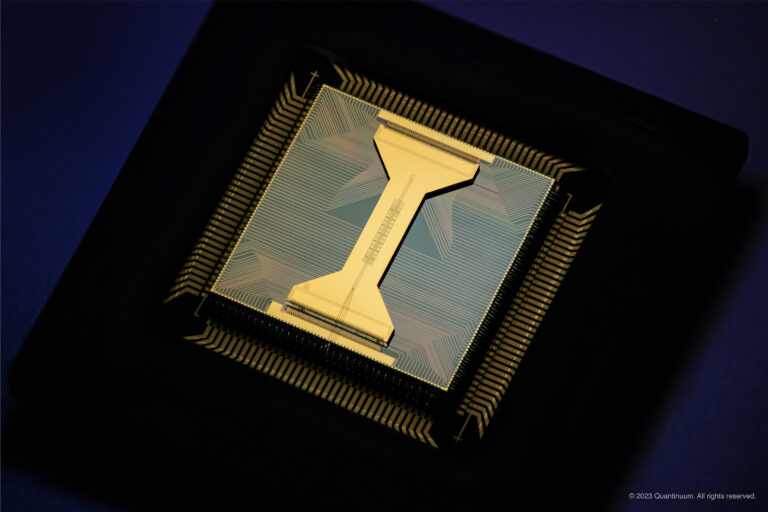
Quantinuum H-1 Chip

Quantinuum and Oracle Partner to Bring Helios Quantum Computer to Oracle Cloud Infrastructure for Hybrid Quantum-AI Workloads

Quantinuum and Oracle announced a multi-year partnership on August 11, 2026, to deploy the Helios quantum computer inside a U.S. Oracle Cloud Infrastructure AI data center. OCI customers will access the 98-physical-qubit trapped-ion system through a planned quantum service alongside HPC and GPU resources. The collaboration targets hybrid quantum-AI applications in drug discovery, materials science, and financial modeling.

Read More »

Mitsubishi Electric’s ME Innovation Fund Invests in JIJ for Quantum Mathematical Optimization Middleware

Mitsubishi Electric Corporation announced its ME Innovation Fund has invested in JIJ Inc., a Japanese startup developing mathematical optimization middleware which leverages quantum computers. This is the fund’s fifteenth investment and aims to explore combining JIJ’s JijZept development platform with Mitsubishi Electric’s quantum technologies, including ongoing interconnection work. The collaboration seeks to support practical implementation of optimization solutions for industrial challenges. Statements from both companies highlight the potential to advance quantum and optimization applications in business.

Read More »

IBM Demonstrates Verified Quantum Results That Challenge Classical Methods

IBM and partners from the University of Chicago, Qedma, and Algorithmiq announced three demonstrations of verified quantum results on July 30, 2026. Using Heron processors, the teams executed encoded circuits with up to 70 logical qubits, 74-qubit Floquet dynamics with QESEM mitigation, and heterogeneous matter simulations. Classical methods showed diverging or inconclusive results at the scales reached. Validation frameworks and open release to the Quantum Advantage Tracker enable continued community scrutiny of the claims.

Read More »

Telefónica and Würth Deploy Quantum Computing for Logistics Packaging Optimization, Reducing Transport Volume

Telefónica and Würth España have completed a pilot that applies quantum computing and artificial intelligence to optimize product packing at a major Spanish logistics center. Working with TECNALIA and QCentroid at Telefónica’s Bilbao quantum technologies center, the team processed more than 6,000 orders. Packaging efficiency improved, shipping boxes reduced, truck transport volume declined, and cardboard use fell. The results illustrate practical hybrid quantum-classical value for high-volume industrial logistics today.

Read More »
IQM Logo

IQM and Deutsche Bahn Demonstrate Hybrid Quantum Algorithm for Railway Scheduling on Real Operational Data

IQM Quantum Computers and Deutsche Bahn have published results of a hybrid quantum-classical algorithm applied to real railway scheduling data. The approach used the Quantum Approximate Optimization Algorithm on a dataset of 190 trips across five German cities, generating roughly 98,500 possible cycles. Feasible schedules were produced end-to-end on existing IQM hardware, with solution quality scaling alongside larger quantum subproblems. The framework is designed for generalization to logistics, energy, and manufacturing optimization problems.

Read More »

QuiX Quantum Delivers Carina Core Hardware Platform for 8-Qubit Photonic Quantum Computing

QuiX Quantum has delivered the Carina core hardware platform, an 8-qubit universal photonic quantum computing demonstrator based on 4-qubit graph states. The system, developed under the UPQC project with the German Aerospace Center (DLR), features chip-integrated photon sources, multiplexed generation of resource states, and a 10 MHz clock cycle with support for more than 10 optimized gate operations per cycle. A dedicated emulator provides simulation and circuit optimization capabilities. Carina advances practical research into algorithms such as Shor’s, Deutsch’s, Grover’s, and quantum teleportation while supporting error correction studies. The low-power design positions the platform for hybrid computing environments.

Read More »

Get The Qubit Report delivered straight to your inbox.

Sign up to receive our newsletter and other reports.

We keep your data private and share your data only with third parties that make this service possible. Read our privacy policy for more info.