
Alice & Bob Launches Helium Multi-Cat-Qubit Platform for Third-Party Quantum Error Correction Experiments
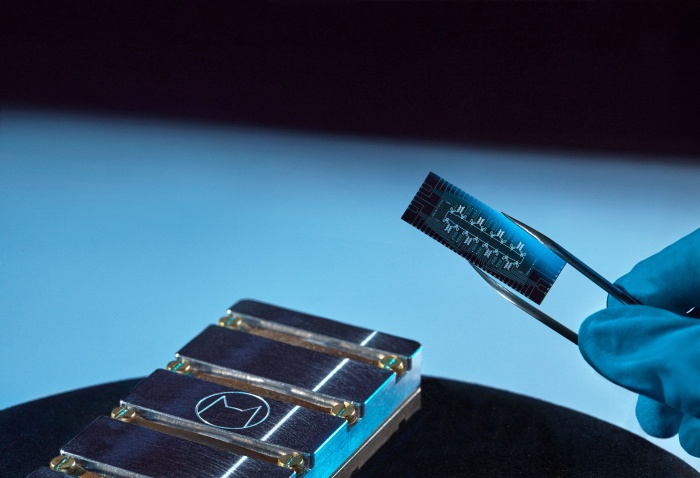
Alice & Bob’s Helium superconducting chip. Image courtesy of Alice & Bob.
Key Takeaways
Helium Platform Availability: Alice & Bob has opened its Helium error-correction platform—the first multi cat-qubit system made available to third-party organizations—for collaborative research on hardware-efficient fault tolerance.
Hardware Performance: The 18-qubit system achieves bit-flip times exceeding one hour and 94.2% Z-gate fidelity in 26.5 nanoseconds, highlighting the efficiency of its noise-biased cat qubit design.
Scaling Ambition: A new $50 million Paris laboratory and €130 million ($142 million USD) in funding support the roadmap to a 100-logical-qubit Graphene quantum computer by 2030.
The French quantum computing company, Alice & Bob, has made its Helium platform available to third-party organizations, marking the first multi cat-qubit system offered externally for quantum error correction research and experimentation. The compact, upgradeable system integrates an 18 noise-biased cat-qubit chip with degree-2 connectivity and a dedicated control interface, enabling researchers to explore hardware-efficient paths to early fault-tolerant quantum computing. The development is backed by the company’s €130 million ($142 million USD) in total funding and a recently announced $50 million product development laboratory in Paris designed to accelerate prototyping of next-generation chips.
Technical Specifications & Implementation Approach
The Helium platform serves as a purpose-built error correction laboratory centered on a multi cat-qubit architecture. Cat qubits are superconducting qubits engineered with strong noise bias that intrinsically suppresses bit-flip errors, allowing error correction codes to concentrate resources on phase-flip errors and thereby reducing the physical qubit overhead required for logical operations.
Key technical parameters include:
- Chip Configuration: 18 cat qubits with degree-2 connectivity, designed to support one logical qubit through repetition codes with a target logical error rate of 10⁻².
- Performance Metrics: Measured bit-flip times greater than one hour; Z-gate fidelity of 94.2% achieved in 26.5 nanoseconds.
- Cryogenic and Control Infrastructure: Processor operates at 10 mK inside a custom cryostat. The full rack-scale system measures 2.4 m wide × 3.3 m high × 9 m long, occupies 21 m², and requires 40 kW of power. Precision microwave control electronics deliver pulses through the cryogenic environment.
- Control and Monitoring Interface: Unified software environment for visualizing cat-qubit dynamics, tracking real-time chip utilization for job scheduling, and monitoring individual rack instruments.
- Site Preparation Requirements: Host facilities must provide ambient temperatures of 18–25 °C, relative humidity between 45–65%, and maximum acoustic noise of 60 dB to ensure stable operation.
Commercial Positioning & Market Integration
By opening the Helium platform to external research teams, Alice & Bob is accelerating validation of its cat-qubit approach while building collaborative momentum toward practical FTQC systems. The company has shown that its architecture can reduce hardware requirements for useful large-scale fault-tolerant quantum computers by up to 200 times compared with conventional superconducting platforms.
This efficiency drives the commercial roadmap. A 4,000 m², $50 million purpose-built laboratory in Paris—equipped through partnerships with Quantum Machines for hybrid control solutions and Bluefors for a cryostat farm supporting up to 20 dilution refrigerators—will host nanofabrication capabilities and dedicated space for next-generation chips. The facility will support development of the Lithium and Beryllium generations leading to Graphene, a 100-logical-qubit quantum computer planned for 2030.
By enabling rapid prototyping and client-accessible testing environments, the Paris lab positions Alice & Bob to move cat-qubit systems from laboratory demonstrations toward market-ready products with substantially smaller footprints, lower energy demands, and reduced infrastructure requirements, facilitating earlier integration with high-performance computing workloads.
Find out more here.
Further articles, reports, and the latest quantum computing news may be found at The Qubit Report.
Related Articles
Quantum Computing Weekly Round-Up: Week Ending September 19, 2026
Anderon, an IBM company, finalized a $1 billion CHIPS award to scale a U.S. 300 mm quantum wafer foundry, while the Department of Energy opened
The Qubit Report: September 17, 2026
Anderon finalized a $1 billion CHIPS award for its Albany 300-millimeter quantum foundry as IBM stacked another $1 billion behind the same line. The same
IQM to Deliver First South America Quantum Computer to Eldorado
IQM signed a purchase agreement on to put an IQM Spark at Brazil’s Eldorado Research Institute in Campinas in the first quarter of 2027. The