
Completed: Yale Facility for Free-Space Quantum Link Across Long Island Sound
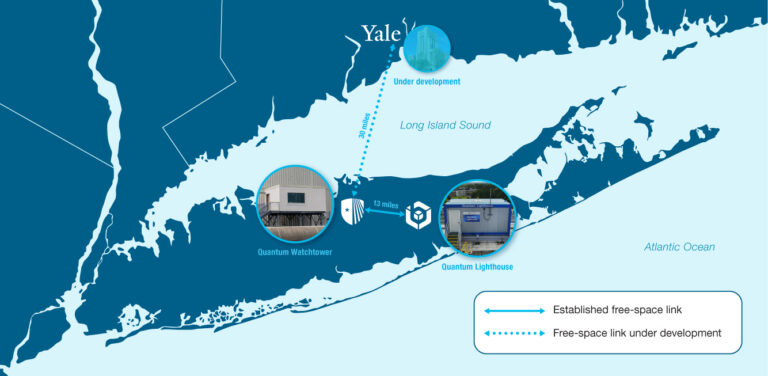
Map of the FSO quantum link connecting Brookhaven National Laboratory, Stony Brook University and Yale University. Image: Jennifer Abramowitz/Brookhaven National Laboratory
Key Takeaways
Yale Optical Facility: Yale University has completed an optical facility in New Haven forming the third facility in the free-space optical quantum link.
Demonstrated Transmission: The Stony Brook–Brookhaven 13-mile leg has achieved daytime transmission of quantum states containing only a few photons and nighttime transmission and detection of entangled photons across the FSO link.
Network Extension: The demonstration establishes free-space transmission of quantum information and advances plans for entanglement distribution across Long Island Sound.
Yale University has completed an optical facility in New Haven as part of a planned free-space quantum link with Stony Brook University and Brookhaven National Laboratory. By adding a wireless capability, the demonstrated free-space link extends the region’s existing 161-mile fiber-based quantum network spanning Long Island and the New York area. Looking ahead, the forthcoming Stony Brook–Yale Q-LATS connection would span approximately 30 miles (48 km) across Long Island Sound.
Adaptive Optics and Beam Transmission
Yale’s Q-LATS system is designed around a telescope with a 25-inch mirror and adaptive optics to correct for atmospheric turbulence in real time. Beyond the primary optics, the design incorporates beam expansion and focusing, alignment and beacon beams, and precision timing synchronization. Researchers are also exploring infrared wavelengths suited to quantum processors and related technologies. On the already operational segment, the Stony Brook–Brookhaven leg of 13 miles (21 km)—linking the Quantum Watchtower at Stony Brook with the Quantum Lighthouse at Brookhaven—has demonstrated daytime transmission of quantum states containing only a few photons and nighttime transmission and detection of entangled photons across the FSO link. Fog, daytime background light, atmospheric turbulence, and weather continue to pose transmission challenges. In parallel, the related Q-LATS project at Yale is led by Hong Tang.
Regional Network Expansion and Goals
Complementing these free-space advances, the effort aligns with the broader SCY-QNet project, an NSF-backed National Quantum Virtual Laboratory initiative led by Stony Brook University in collaboration with Columbia University, Yale University, and Brookhaven National Laboratory. Under this program, partners aim to build a 10-node wide-area network connecting atomic quantum processing units, quantum memories, entanglement sources, frequency converters, and other quantum-networking technologies across the institutions, along with additional fiber links to Columbia and other nodes.
Beyond near-term entanglement distribution, objectives include quantum-secure communications which overcome fiber limitations, the interconnection of quantum devices for distributed computing and sensing, and work to support future satellite-connected quantum networks and broader quantum-internet applications. In this context, the planned extension could strengthen the region’s position in metropolitan-scale quantum networking. Support for the broader effort comes from New York State investments and NSF funding. With the Yale facility now complete, researchers will soon begin establishing the Stony Brook–Yale connection.
Bottom Line
The Stony Brook–Brookhaven demonstration advances free-space quantum networking, while Yale has completed the third facility needed to extend the capability across Long Island Sound.
Find out more here.
—
Further articles, reports, and the latest quantum computing news may be found at The Qubit Report.
Related Articles
The Qubit Report: October 8, 2026
Oratomic’s Series B put a $5.4 billion valuation on a Pasadena neutral-atom startup that has raised $775 million since March. The same day Universal Quantum
The Qubit Report: October 7, 2026
The Qubit Report: October 7, 2026 Quantum computing news is a slog with worse decoherence than your attention span. Dip your whiskers in The Qubit
The Qubit Report: October 6, 2026
Australia’s stage-two quantum grants total $12.3 million, not the $123 million sitting in the URL slug, the same day Xanadu and GlobalFoundries called a manufacturing