

The Pittsburgh Supercomputing Center (PSC), in partnership with Hewlett Packard Enterprise (HPE) and Rigetti Computing, will construct TangleLab, a hybrid quantum-classical supercomputing testbed. The project is funded by a $5 million grant from the National Science Foundation under the Advanced Computing Systems & Services program (award #2537076). Rigetti will supply a 9-qubit Novera quantum processing unit integrated with HPE classical high-performance computing hardware. Construction is scheduled to begin September 1, 2026, at PSC’s new data center, with full operations planned for 2027.
Hybrid System Architecture and Components
TangleLab combines a superconducting quantum processor with classical accelerators to support hybrid quantum-classical workflows. The quantum component is a Rigetti Novera QPU featuring a 9-qubit chip based on a 3×3 array of tunable transmons with tunable couplers for fast two-qubit operations, plus a separate 5-qubit chip for single-qubit characterization. Superconducting systems deliver gate speeds of 50-70 nanoseconds, a metric highlighted by Rigetti CEO Dr. Subodh Kulkarni as advantageous for high-performance hybrid environments. Classical resources include HPE ProLiant Compute DL384 Gen12 and DL385 Gen11 servers, HPE Cray Storage Systems C500, and HPE Networking infrastructure.
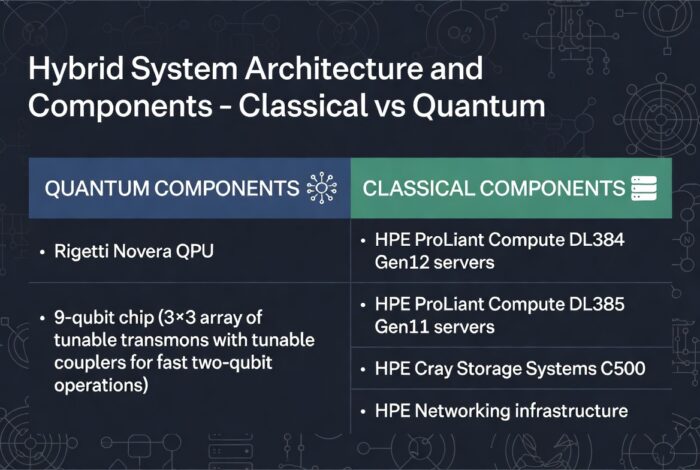
These elements enable pre-processing, compilation, workload management, and orchestration across quantum and classical resources. Masoud Mohseni, Senior Distinguished Technologist and Director of HPE Quantum at HPE Labs, noted that the testbed will allow researchers to benchmark hybrid applications and understand integration from early pipeline stages through system-level operation.
The design continues PSC’s experience since 1991 with heterogeneous supercomputers that route problem segments to the most suitable processors.
Research Access and Ecosystem Impact
PSC will allocate TangleLab time through a flexible competitive proposal process, supporting dedicated researcher access alongside real-time educational use for classes and workshops. Onboarding, training, and research consulting will be provided to users across experience levels.
Principal Investigator Barr von Oehsen, PSC Executive Director and Vice Chancellor for Research Computing at the University of Pittsburgh, described the system as extending the center’s tradition of making next-generation technologies available to the broader research and education community while helping develop a quantum-ready workforce. Co-principal investigators include Bruno Abreu of PSC; Bruce Childers, Dean and Professor in the School of Computing and Information at the University of Pittsburgh; Masoud Mohseni of HPE; and Andrew Bestwick, Senior Vice President of Quantum Systems at Rigetti Computing.
The effort builds on the existing strategic collaboration between Rigetti and HPE to commercialize quantum-enabled high-performance computing systems for research institutions, public-sector organizations, and enterprises. TangleLab addresses national priorities outlined in Office of Science and Technology Policy memorandum M-25-34/NSTM-2 for fiscal year 2027, focusing on quantum information science and artificial intelligence advancement. PSC is a joint center of Carnegie Mellon University and the University of Pittsburgh.
Bottom Line
TangleLab establishes an accessible hybrid quantum-classical testbed that advances integrated workflows and workforce preparation under NSF support.
Find out more here.
—
Further articles, reports, and the latest quantum computing news may be found at The Qubit Report.