
SEALSQ and Quobly Sign $5M Commercial Agreement to Integrate Post-Quantum Security into Silicon Quantum Computing Platforms
Key Takeaways
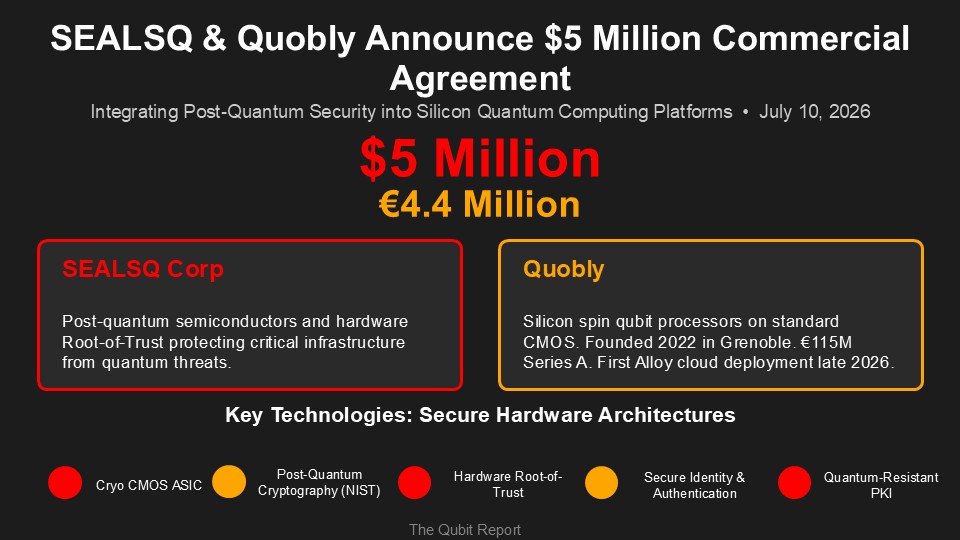
Agreement Milestone: SEALSQ and Quobly execute a $5 million commercial agreement to integrate post-quantum security into silicon quantum computing platforms.
Security Technology Scope: Integration includes Cryo CMOS ASICs, hardware Root-of-Trust, NIST-aligned post-quantum cryptography, and quantum-resistant PKI for quantum infrastructure protection.
Ecosystem Context: The deal advances prior collaboration and Quobly’s €115 million Series A toward secure, sovereign European quantum computing commercialization.
Today, SEALSQ Corp and Quobly, a developer of silicon-based quantum processors, announced a $5 million (€4.4 million) commercial agreement on July 10, 2026. Under the terms, Quobly will incorporate SEALSQ’s post-quantum security technologies, secure semiconductor solutions, and engineering services into its scalable quantum computing platforms. The agreement represents the commercialization phase of a strategic collaboration first disclosed in November 2025 and follows SEALSQ’s strategic investment in Quobly, which recently secured €115 million in Series A funding to accelerate industrialization of its Alloy product line.
Secure Hardware Architectures for Quantum Computing Platforms
The collaboration focuses on embedding cybersecurity directly into quantum system hardware from the design stage. SEALSQ will provide technologies including:
Cryo CMOS ASICs for quantum computing architectures
Post-quantum secure semiconductor architectures and secure elements
Hardware-based Root-of-Trust technologies for authenticating quantum infrastructure and connected systems
Post-quantum cryptographic technologies based on NIST-standardized quantum-resistant algorithms.
Secure identity and authentication technologies for quantum processors, control electronics, and distributed infrastructure
Quantum-resistant PKI and trusted provisioning technologies
Engineering, integration, and security architecture services
These solutions address the need to protect quantum processors, cryogenic control electronics, classical computing interfaces, communications networks, and cloud connections against both classical and quantum-enabled threats as quantum systems transition to industrial-scale deployments. Quobly’s CMOS-compatible silicon spin qubit technology enables manufacturing compatibility with established semiconductor processes, supporting scalability objectives.
Commercial Deployment and European Sovereignty Objectives
The combined platform leverages Quobly’s silicon spin qubit technology and scalable processor architecture alongside SEALSQ’s post-quantum semiconductor and hardware security capabilities. Target markets encompass government and sovereign computing infrastructure, defense and national security, quantum data centers and high-performance computing, financial services, pharmaceutical and life sciences research, artificial intelligence infrastructure, critical infrastructure, and secure cloud computing.
Quobly intends to offer its first-generation Alloy Pioneer quantum computer through cloud environments by the end of 2026, targeting early adopters in high-performance computing and research. The companies position the partnership as a contribution to a secure European quantum computing ecosystem, combining design, manufacturing via established semiconductor processes, protection, and operation of strategic quantum infrastructure.
Bottom Line
The agreement creates a commercial pathway to integrate hardware-based post-quantum security into Quobly’s scalable silicon quantum computing platforms.
Find out more here.
—
Further articles, reports, and the latest quantum computing news may be found at The Qubit Report.
- Alloy Pioneer Quantum Computer, Cryo CMOS ASICs, europe, Hardware Root-of-Trust, Post-Quantum Security, Quantum Infrastructure Protection, Quantum-Resistant Public Key Infrastructure, Quobly, SEALSQ Corp, Semiconductor Manufacturing, Series A Funding, Silicon Quantum Computing, Silicon Spin Qubit Technology, Sovereign European Quantum Computing
Related Articles
The Qubit Report: October 8, 2026
Oratomic’s Series B put a $5.4 billion valuation on a Pasadena neutral-atom startup that has raised $775 million since March. The same day Universal Quantum
The Qubit Report: October 7, 2026
The Qubit Report: October 7, 2026 Quantum computing news is a slog with worse decoherence than your attention span. Dip your whiskers in The Qubit
The Qubit Report: October 6, 2026
Australia’s stage-two quantum grants total $12.3 million, not the $123 million sitting in the URL slug, the same day Xanadu and GlobalFoundries called a manufacturing