

Researchers at Zhejiang University have demonstrated the world’s first prototype of a quantum random access memory (QRAM) implemented on a superconducting quantum chip, marking a significant step toward practical quantum computing by solving the data access bottleneck that limits current systems. The work, published in the March issue of Nature Physics, enables the prototype to access and retrieve 4-bit and 8-bit classical data simultaneously in superposition with approximately 60 percent accuracy. Led by assistant professor Lu Liqiang, the achievement provides the first experimental validation of a functional QRAM architecture and positions Chinese research competitively as global powers intensify investments in quantum technologies.
Technical Design & Implementation Specifications
The QRAM prototype integrates a quantum random access memory architecture directly onto a superconducting quantum processor. Unlike conventional quantum memory that stores quantum states, QRAM specifically loads and provides random access to classical binary data (represented as 0s and 1s) while preserving the ability to process that data in quantum superposition. This design enables the quantum system to examine multiple data entries concurrently rather than processing them sequentially, which is essential for maintaining quantum speed advantages when working with large classical datasets.
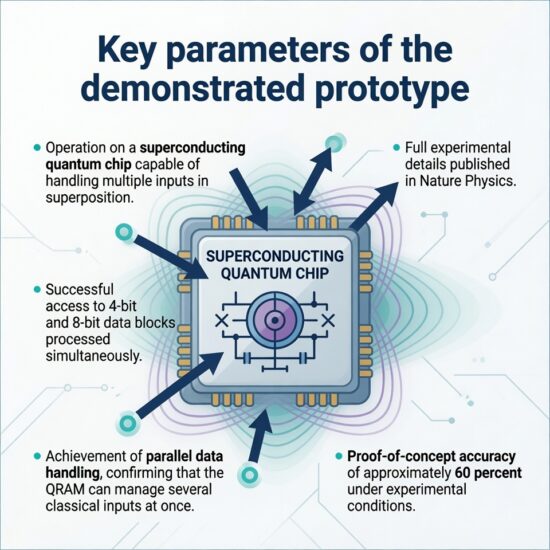
Key parameters of the demonstrated prototype include:
- Operation on a superconducting quantum chip capable of handling multiple inputs in superposition.
- Successful access to 4-bit and 8-bit data blocks processed simultaneously.
- Achievement of parallel data handling, confirming that the QRAM can manage several classical inputs at once.
- Proof-of-concept accuracy of approximately 60 percent under experimental conditions.
- Full experimental details published in Nature Physics.
“We have succeeded for the first time in operating a QRAM prototype that can access 4-bit and 8-bit data on a superconducting quantum chip,” stated Lu Liqiang. “We have proven that QRAM can process multiple data inputs simultaneously.” The team further noted that without efficient classical data access mechanisms, many theoretically powerful quantum algorithms remain impractical on actual hardware.
Market Positioning & Commercial Impact
China has elevated quantum technology to one of seven designated future industries under the 15th Five-Year Plan, reflecting a coordinated national strategy to develop core capabilities across the quantum stack. The QRAM demonstration strengthens China’s position in the critical interface layer between classical data infrastructure and quantum processors, an area widely viewed as necessary for scaling quantum computers beyond current laboratory demonstrations.
The global quantum technology market reached an estimated $8 billion in 2024, with China accounting for roughly 25 percent of activity. In parallel, the United States has reinforced its ecosystem through major public funding, including more than $2 billion allocated under the CHIPS Act to quantum computing companies such as IBM and additional developers.
While the current prototype remains at laboratory scale and significant engineering challenges persist—including raising accuracy above 99 percent, scaling to millions of bits, implementing effective error correction, and achieving broader operational robustness—progress on foundational components such as QRAM is essential for eventual commercial integration. Industry consensus indicates that translating such interface technologies into full algorithms and deployable applications will require sustained effort over at least the next decade, yet each validated milestone accelerates the pathway toward practical quantum advantage in data-intensive sectors.
Find out more here.
Further articles, reports, and the latest quantum computing news may be found at The Qubit Report.