
Tag: United States

Quantum Independence: U.S. Advances Cement American Leadership on the 250th Anniversary

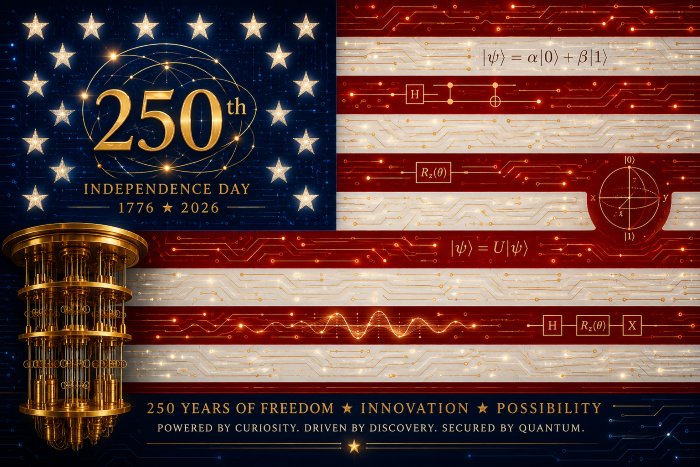
This July 4th, as America marks 250 years of independence, a quantum chip from Berkeley Lab is being sealed in the national time capsule in Philadelphia. Recent demonstrations of verifiable quantum advantage by Google’s Willow processor, IBM’s hardware roadmap, and IonQ’s commercial milestones highlight U.S. dominance across superconducting, trapped-ion, and neutral-atom platforms. With the CHIPS Act fueling domestic manufacturing (the new Anderon foundry) and strong federal support through the National Quantum Initiative, the United States is building the foundation for fault-tolerant quantum computers by decade’s end. These achievements ensure that the next 250 years of innovation will be shaped by American quantum leadership.

Read More »

NSA and DEVCOM Army Research Office Launch QuantumEAGLe Initiative to Advance Quantum Computing Ecosystem

The National Security Agency and DEVCOM Army Research Office have launched the QuantumEAGLe Initiative to accelerate the U.S. quantum computing ecosystem. The program targets five interconnected priorities: industry engagement, commercial roadmaps, supply chain advancement, algorithmic applications, and foundational research. It aims to overcome technical barriers and enable fault-tolerant quantum computers. The initiative strengthens domestic manufacturing capabilities while aligning with the President’s Quantum Executive Order for national and economic security. Industry quotes highlight the collaborative push to maintain U.S. leadership in quantum technology.

Read More »
Encryption Risk Roadmap

Quantum Computing Weekly Round-Up: Week Ending June 20, 2026​​

The quantum sector accelerated from research to real deployments and policy mandates in mid-June 2026. The UK and Japan sealed a $24 billion partnership while the US and France advanced legislation and sovereign quantum infrastructure. Hardware from IQM reached Oak Ridge National Laboratory and photonic systems arrived in Japan, with PsiQuantum starting construction on a utility-scale system in Australia. Researchers achieved passive error correction at the break-even point and companies launched scalable post-quantum security platforms. Enterprises such as Rolls-Royce and Cleveland Clinic are integrating quantum tools into industrial and medical workflows, signaling a shift to procurement.

Read More »

QTREX Produces Single-Build Cryogenic Chip Carrier for Quantum Processor Interface

QTREX Quantum Ltd. has successfully produced a cryogenic chip carrier fabricated through its proprietary single-build AME process. The component was developed from a design supplied by one of the world’s largest U.S.-based quantum computing companies. This milestone extends QTREX’s technology into the processor-interface layer, supporting higher channel counts, lower thermal load, and improved signal integrity. QTREX plans to present the chip carrier sample during private meetings in Boston around Quantum.Tech World 2026.

Read More »

Zhejiang University Achieves Breakthrough with World’s First Superconducting QRAM Prototype

Researchers at Zhejiang University have demonstrated the world’s first prototype of a quantum random access memory (QRAM) on a superconducting quantum chip. The system successfully accesses 4-bit and 8-bit classical data simultaneously in superposition with approximately 60 percent accuracy. Published in Nature Physics, this achievement validates QRAM architecture and helps overcome critical data access limitations in quantum computing. Led by assistant professor Lu Liqiang, the work strengthens China’s position in quantum technologies.

Read More »

Reliance Global Group Positions EnQuantum to Secure the Post-Quantum Economy Before Q-Day

Reliance Global Group, Inc. (Nasdaq: EZRA) has issued an update on its EnQuantum Ltd. investment, signaling strong positioning in the post-quantum cybersecurity space. EnQuantum is developing an FPGA-accelerated hash-based cryptography platform that offers terabit-scale throughput and significant energy efficiency gains. The technology targets high-performance environments including AI infrastructure, 5G networks, and critical communications. With backing from the Israel Innovation Authority and alignment to U.S. quantum policy incentives, EnQuantum is preparing networks for the challenges of Q-Day.

Read More »

SMBC and Toshiba Launch SMBC/TOSHIBA Quantum Driven Diversified Japan and U.S. Equity Indices

Sumitomo Mitsui Banking Corporation and Toshiba Corporation have jointly developed the SMBC/TOSHIBA Quantum Driven Diversified Equity Indices using Toshiba’s Simulated Bifurcation Machine. These indices select low-correlation stocks from major Japan and U.S. universes to maintain strong diversification even during market shocks. Quarterly rebalancing incorporates liquidity and transaction-cost controls while a joint patent is pending. The collaboration with S&P Dow Jones Indices opens the path to index funds, ETFs, and other commercial products.

Read More »
NIST Logo Black and White

NIST Advances Nine Candidates to the Third Round of Additional Post-Quantum Digital Signatures

The U.S. National Institute of Standards and Technology (NIST) has advanced nine digital signature algorithms to the third round of its Additional Post-Quantum Cryptography standardization process. These candidates offer diverse options including compact isogeny-based SQIsign and efficient lattice-based HAWK schemes. The selection enhances resilience against quantum threats for applications from IoT devices to software signing and TLS certificates.

Read More »

Haiqu Launches Agentic Quantum Operating System to Accelerate Enterprise Quantum R&D

Haiqu has introduced its Agentic Quantum Operating System (HaiquOS), a full-stack quantum intelligence platform that combines agentic AI with proprietary middleware. The solution helps R&D teams identify suitable problems, design experiments, and interpret results from today’s noisy quantum hardware with minimal custom engineering. Internal benchmarks show dramatic efficiency gains, including a molecular dynamics simulation reduced from over nine hours and $30,000 to roughly 30 seconds and $25. HaiquOS is already gaining interest from organizations including Capgemini and Deloitte.

Read More »

Get The Qubit Report delivered straight to your inbox.

Sign up to receive our newsletter and other reports.

We keep your data private and share your data only with third parties that make this service possible. Read our privacy policy for more info.