
Singapore Armed Forces Partner with IBM to Explore Quantum Computing for Mission Planning and Logistics Optimisation
Key Takeaways
Early Engagement: Singapore’s Digital and Intelligence Service and Defence Science and Technology Agency begin hands-on evaluation of quantum optimisation for defense mission planning.
Expertise Development: DIS and DSTA engineers will access IBM quantum resources and develop practical skills in algorithms and programming frameworks.
Operational Focus: Collaboration targets complex logistics and resource allocation problems that scale beyond classical computing efficiency.
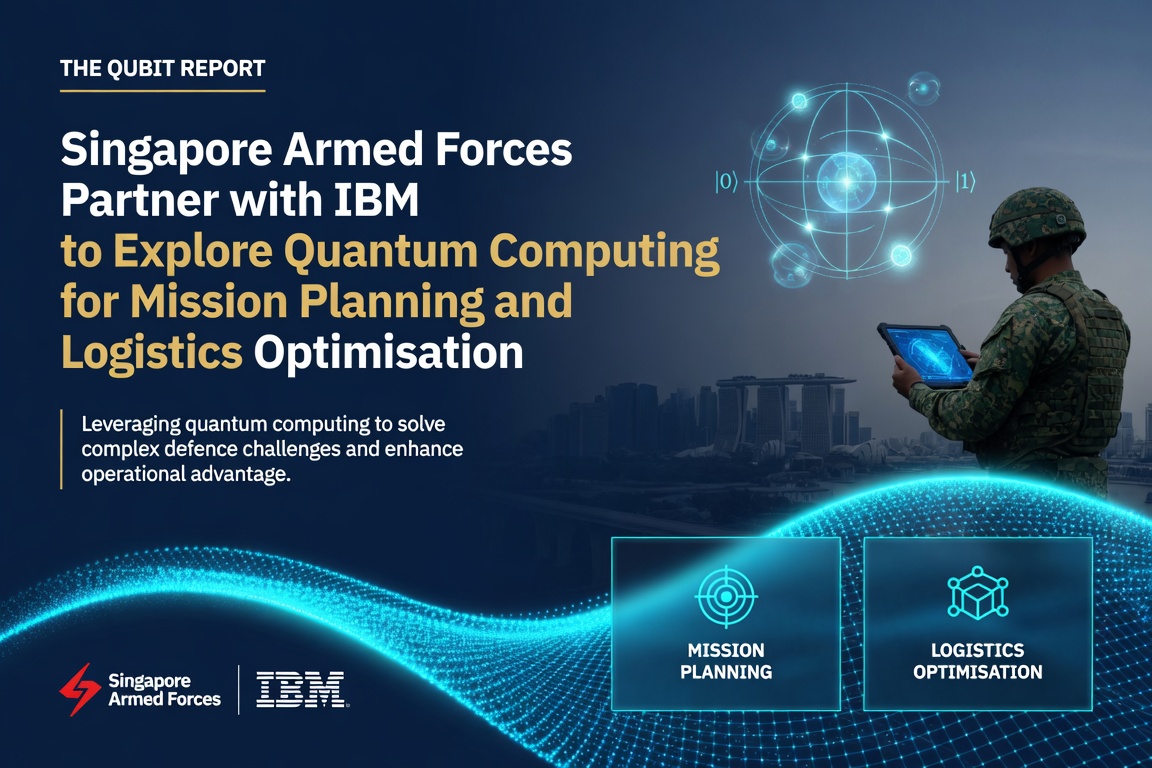
On July 21, 2026, the Singapore Armed Forces’ Digital and Intelligence Service (DIS) and Defence Science and Technology Agency (DSTA) announced a partnership with IBM to explore quantum computing for complex mission planning, including logistics optimisation use cases. Under the collaboration, DIS and DSTA engineers will work with IBM specialists to develop and evaluate quantum optimisation approaches for representative mission planning problems while building indigenous expertise and gaining cloud access to IBM’s quantum computing resources. Military Expert 7 Guo Jinghua, Commander of the SAF C4 and Digitalisation Command, noted the importance of early engagement to understand both opportunities and limitations as the technology matures.
Quantum Approaches to Complex Planning
Mission planning requires balancing numerous operational constraints, resources, and timelines. Quantum optimisation is being assessed for its potential to address combinatorial problems more efficiently than classical methods. One illustrative logistics scenario involves routing 20 supply trucks or fuel bowsers across 50 locations, creating a quintillion possible route combinations; each additional variable expands the search space exponentially. Classical systems require progressively longer computation times to identify optimal paths, whereas quantum approaches are designed to examine large solution spaces for probable outcomes more rapidly.
The partners will apply quantum algorithms to selected planning processes, focusing on resource allocation and logistics efficiency that could later extend to scenarios involving unmanned systems. Scott Crowder, Vice President of IBM Quantum Adoption and Business Development, confirmed that DIS and DSTA will receive cloud access to IBM quantum compute resources along with enablement support to explore applicability in planning and resource allocation.
Capability Building for Defense Readiness
The collaboration forms part of broader DIS and DSTA efforts to strengthen future digital capabilities and ensure the Ministry of Defence and Singapore Armed Forces remain prepared to harness emerging technologies.
DSTA Deputy Chief Executive (Information) Gayle Chan emphasised the application of systems engineering expertise to determine where quantum technologies can deliver meaningful impact on future mission planning.
Guo Jinghua stated that investing in people and capabilities today positions the organisation to harness quantum technologies as they mature, while building partnerships with industry. The initiative prioritises practical skill development in quantum computing, algorithms, and programming frameworks among defense engineers rather than immediate operational deployment, recognising that reliable, large-scale utility remains several years away.
US Armed Forces Preparation for Quantum Capabilities
The United States Department of Defense has pursued parallel efforts to evaluate quantum and hybrid approaches for complex planning and logistics challenges. DARPA’s Optimization with Noisy Intermediate-Scale Quantum devices (ONISQ) program specifically targeted combinatorial optimisation problems of defense relevance, including route planning, sensor-to-target assignment, and real-time supply chain management across the DoD logistics enterprise. The Department of the Air Force has issued contracts focused on quantum computing algorithms for military logistics, addressing fleet routing, maintenance scheduling, and supply-chain resilience under uncertainty. Earlier awards supported quantum software for inventory management.
The US Government maintains designated Quantum Information Science Research Centers, while successive National Defense Authorization Acts have required annual identification of near-term technical challenges quantum systems could address, authorised pilot programs, and directed a Quantum Benchmarking Initiative to assess pathways to utility-scale capability. These activities emphasise hybrid quantum-classical methods, workforce development, and application exploration, consistent with assessments that broadly useful fault-tolerant quantum computing remains at least a decade away.
Bottom Line
Singapore’s defense organisations are establishing foundational quantum expertise and evaluating optimisation use cases for mission planning with IBM support.
Find out more here.
—
Further articles, reports, and the latest quantum computing news may be found at The Qubit Report.
Related Articles
QDNL Convenes Benelux-QCI Partners to Advance EuroQCI QKD Priorities
On October 22, 2026, QDNL hosted the Benelux-QCI event in Utrecht to advance cross-border quantum key distribution under EuroQCI. Partners from the Netherlands, Belgium, Luxembourg
Quantum Computing Weekly Round-Up: Week Ending October 24, 2026
Quantinuum posted 99.9995 percent logical fidelity, a 10x jump that keeps its 2029 fault-tolerant target alive. NVIDIA ran the biggest realistic fault-tolerant simulation yet and
The Qubit Report: October 22, 2026
Quantinuum and Oracle opened early Helios access on OCI while Qblox measured sub-4 µs hybrid loops on a single desktop. Decoder analysis shows correlated matching