
The Qubit Report: October 27, 2026
The Qubit Report for October 27, 2026 arrives with processors rewriting magnet theory, wave algorithms stretching into acoustics and structural loads, and defense networks locking Korean and Indian post-quantum roots of trust before the calendar flips again.
Neutral Atoms and Wave Physics Deliver Unexpected Results
A 16-by-16 grid of interacting atomic spins on the Pasqal neutral-atom processor settled far more slowly after a quench than three classical methods or existing theory predicted.
This exposed a relaxation bottleneck in two-dimensional quantum magnets where current models diverge. The same platform also showed XY-like behavior under strong fields.
Meanwhile the Quantum Art wave algorithm, first shown for electromagnetic cases, builds a circle of physically allowed directions from the fixed frequency-speed relation and marks sources so success rates climb as more sources appear. A three-dimensional radio-wave map over tens of kilometers at centimeter accuracy becomes plausible with roughly 100 trapped-ion qubits. Classical grid points of 10^18 to 10^21 give way to slowly growing effort as area or detail increases.
Post-Quantum Defenses Move from Pilots to Hardware
IDEMIA and KT placed both NIST-standardized and Korean KpqC algorithms onto a Quantum-Resistant SIM and eSIM smart-card platform.
The work forms part of South Korea’s 2026 Post-Quantum Cryptography Pilot Conversion Project run with the Ministry of Science and ICT and KISA. The hardware root of trust handles key generation and operations for defense infrastructures including smart-unit platforms, user PCs, CCTV systems, drones, ground control stations, and 5G environments.
The first KpqC implementation on a smart-card platform in Korea arrived while preserving crypto-agility without device-level redesigns. WISeSat and Kaynes expanded their partnership so SEALSQ post-quantum semiconductors and WISeKey identity features embed into Indian-manufactured satellites from the design stage. Quantum XChange’s Phio TX adds quantum-safe management tunnels, zero-touch provisioning, and flexible PQC algorithm naming.
Full-Stack Plays and Foundry On-Ramps Accelerate Hardware Paths
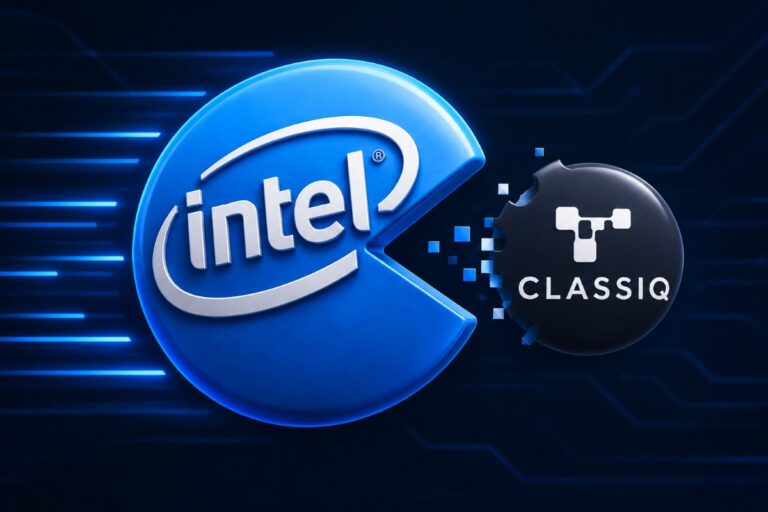
Intel agreed to acquire Classiq’s synthesis platform so the modality-agnostic algorithm layer sits atop Intel’s scalable silicon spin-qubit manufacturing and cryogenic control electronics.
Developers generate optimized circuits without hand-crafted designs. The deal closes in the first half of 2027 subject to approvals.
SkyWater’s OnRamp program opened the same day. Selected early-stage quantum hardware teams receive no-cost access to engineering reviews and a validated manufacturing roadmap on the SP90 200 mm silicon-nitride photonics platform. Trapped-ion, neutral-atom, photonic, networking, and sensing modalities already run with wavelength coverage from 400 nm past 2000 nm.
DARPA and AFRL Keep Funding the Networking and Error-Correction Race
Nord Quantique’s $10 million extension of its DARPA Quantum Benchmarking Initiative Stage B award pushes its bosonic quantum-error-correction approach.
Information encodes inside individual superconducting physical qubits at a one-to-one logical-to-physical ratio. Utility-scale operation by 2033 with smaller footprint and lower energy draw than conventional multi-qubit codes is the target.
IonQ’s $7.5 million follow-on from the Air Force Research Laboratory under its Phase 2 contract builds on the earlier $21.1 million effort. The Rome, New York quantum network gains free-space optical links with automatic pointing, acquisition, and tracking, plus quantum frequency converters for C-band and telecom interoperability.
Superconductivity Simulations and Student Grants Keep Science Moving
Quantinuum and GE Vernova began applying Helios cloud access and the Nexus platform to Fermi-Hubbard models of interacting electrons.
Both s-wave and d-wave superconducting pairing correlations already appear. Lighter generators, more compact motors, and higher-capacity grid equipment become more realistic once the simulations connect more tightly to real materials.
Zurich Instruments’ 2026 grants named Frederik Pfeiffer for high-fidelity two-qubit gates on multimode superconducting P-mon qubits, Lorenzo Graziotto for cavity control of quantum Hall stripes, and Shinichi Inoue for a parametrically driven iSWAP gate at the zero-flux sweet spot.
Country Reports and Global Access Frameworks Map the Landscape
EviDimensional’s State of Quantum released the first editions of its 2026 country sector reports for France, Germany, Italy, the Netherlands, and the United Kingdom.
Each traces capital, investors, buyers, and public contracts to primary records and pairs national programmes with comparator benchmarks including the United States and China. France’s 206-page volume covers 19 companies and 3,622 citations. Germany’s 194 pages examine 38 companies.
Italy’s 184 pages assess five companies with a 27 October cut-off. The set supplies eight findings with falsifiers in every case. The new GESDA-OQI report, drawing on the May 2026 Quantum Diplomacy in Action discussions, argues healthcare, food security, climate, and materials gains require trusted settings for governments, experts, and industry rather than fresh treaties.
Earnings Calendars and Regional Conferences Fill the Calendar
D-Wave’s November 10 results arrive before the open.
A webcast at 8:00 a.m. Eastern includes CEO Alan Baratz and acting CFO Greg Golkov.
Xanadu’s November 11 numbers post after the close with a call at 5:30 p.m. Eastern the same day. CESGA’s Quantum Iberia conference runs 9 and 10 November in Santiago de Compostela.
The Energy Bill for Utility-Scale Quantum Has Not Been Priced
Useful quantum scale will demand continuous tens-of-megawatt draws once cooling, control electronics, and classical orchestration are counted.
Most roadmaps still track qubit counts and fidelities instead of compute per watt or compute per dollar.
A recent EE Times analysis shows a single large QPU generates exponentially more useful work than networked smaller units because inter-node links remain slower and lossier. Architecture and manufacturing choices made now will lock efficiency levels for the next decade.
Bottom Line
Processors rewriting magnet theory, hardware roots of trust already sitting inside defense SIMs and Indian satellites, and foundry on-ramps shortening the lab-to-fab path all land on the same day the energy bill for utility-scale systems remains unpriced.
Sources
- The State of Quantum 2026 country reports | EviDimensional
- IDEMIA Secure Transactions collaborates with KT on post-quantum security for South Korea’s defense | IDEMIA
- Quantum Art extends wave-simulation algorithm to acoustics, structural engineering and materials science | PR Newswire
- New GESDA-OQI report explores how quantum computing can benefit all | GESDA
- Pasqal’s neutral-atom processor uncovers quantum magnet behavior theory did not predict | Pasqal
- Space and Kaynes Space Technology advance post-quantum security for Indian satellites | FinanzNachrichten
- Quantum computing energy bill is coming and we have not priced it in | EE Times
- D-Wave Quantum to report third-quarter 2026 financial results on November 10 | D-Wave
- SkyWater Technology launches OnRamp to support next-generation quantum innovators | SkyWater Technology
- Intel to acquire Classiq to accelerate scalable quantum computing | Intel
- IonQ awarded $7.5 million follow-on funding from AFRL for full-stack quantum networking | IonQ
- Phio TX-CMC 2.0 simplifies quantum-safe network deployments | Quantum XChange
- Nord Quantique secures $10 million DARPA Stage B extension | Nord Quantique
- Quantinuum and GE Vernova collaborate on high-temperature superconductivity research | Quantinuum
- Zurich Instruments announces 2026 student travel grant winners | Zurich Instruments
- Xanadu to report third-quarter 2026 financial results on November 11 | Xanadu
- CESGA hosts the Quantum_Iber_IA Conference 2026 | CESGA
- Quantum SDK comparison | Bloq
—
See today’s news and sources in the The Qubit Reports archive page found here at The Qubit Report.
- bosonic quantum error correction, CESGA, Classiq, D-Wave Quantum, EviDimensional, GE Vernova, GESDA Open Quantum Institute, IDEMIA Secure Transactions, Intel, IonQ, Kaynes Space Technology, KT, neutral atom quantum computing, Nord Quantique, Pasqal, Post-Quantum Cryptography (PQC), Quantinuum, Quantum Art, quantum energy consumption, quantum networking, Silicon Spin Qubits, SkyWater Technology, superconductivity, The Qubit Report, WISeSat.Space, Xanadu
Related Articles
The Qubit Report: October 26, 2026
Dark fiber now carries IonQ quantum key distribution between Palm Beach State College and FAU, lighting the first operational segment of Florida’s statewide quantum-safe network.
QDNL Convenes Benelux-QCI Partners to Advance EuroQCI QKD Priorities
On October 22, 2026, QDNL hosted the Benelux-QCI event in Utrecht to advance cross-border quantum key distribution under EuroQCI. Partners from the Netherlands, Belgium, Luxembourg
Quantum Computing Weekly Round-Up: Week Ending October 24, 2026
Quantinuum posted 99.9995 percent logical fidelity, a 10x jump that keeps its 2029 fault-tolerant target alive. NVIDIA ran the biggest realistic fault-tolerant simulation yet and