
Quantum Computing Weekly Round-Up: Week Ending July 11, 2026
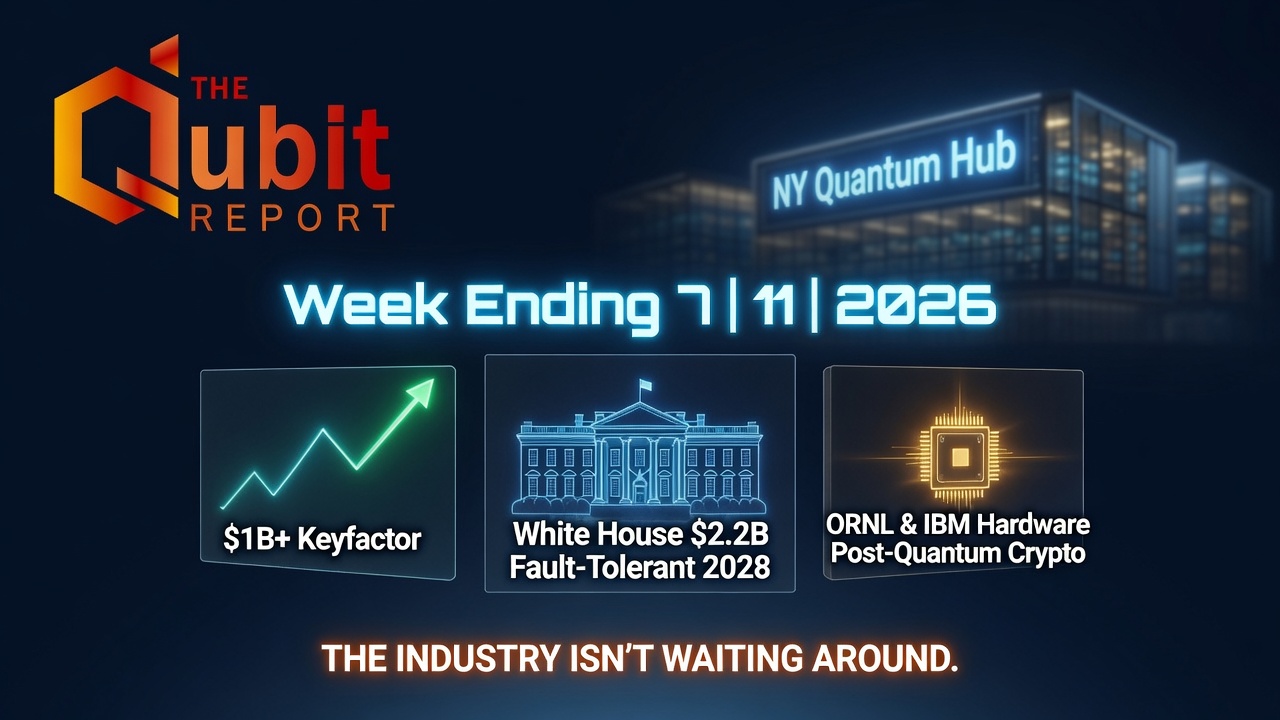
If you blinked this week you missed real money moving, actual hardware landing in national labs, and post-quantum security shifting from slide decks to signed contracts. Governments coordinated at the highest levels while startups and established players alike treated the quantum threat and opportunity like the board-level priority it has become. This Quantum Computing Weekly Round-Up captures the developments that separate spectators from the teams actually building the future.
Money Avalanche
Keyfactor dropped the week’s loudest number with its $1B+ strategic growth investment led by Summit Partners. The cash targets machine identity security, shrinking certificate lifespans, and the urgent push to post-quantum cryptography readiness across hybrid environments. CEO Jordan Rackie framed it as continuity plus acceleration at the exact moment enterprises and regulators are demanding measurable PQC progress before 2030.
Qiz Security followed with a crisp $17 million seed round led by Bessemer Venture Partners and Merlin Ventures. The platform gives enterprises continuous cryptographic discovery, risk modeling, and remediation enforcement — the operational layer most organizations still lack as Q-Day estimates creep closer to 2029. Both raises show capital is now chasing execution, not just whitepapers.
Policy Firepower
The White House Quantum Summit laid out more than $2.2 billion in fresh support explicitly aimed at fault-tolerant quantum computing by 2028, domestic supply chain resilience, and workforce pipelines. DOE is driving the scientifically relevant fault-tolerant machine target while Commerce, Defense Innovation Unit, NSF X-Labs, and NIST each received marching orders on manufacturing, sensing, and post-quantum standards. This is coordination that turns executive orders into funded programs instead of aspirational slides.
States are matching the energy. Illinois launched a new $3 million fund to attract NSF quantum teams, while Shanghai rolled out a quantum computing future industry incubation zone backed by $14.7 million in subsidies. The signal is consistent: governments that want a seat at the table are putting real money on the table now.
Hardware That Actually Ships
ORNL deployed a new 20-qubit IQM superconducting system called Pathfinder inside its Quantum Computer Deployment Lab. The machine integrates directly with classical HPC resources for hybrid workflows in materials simulation, chemistry, and AI — exactly the quantum-centric supercomputing setups the field has been promising for years.
IBM is going bigger in New York, seeking incentives from the Dutchess IDA for a $2.5 billion quantum computing facility in Poughkeepsie, with the first system targeted for 2029 and a more advanced follow-on by 2033. Pasqal and MegazoneCloud signed an MoU to bring neutral-atom quantum computing to South Korean enterprises through managed cloud access and eventual on-premises QPUs, targeting finance, logistics, biotech, and manufacturing use cases.
D-Wave earned one of only two Leaders positions in the latest IDC MarketScape assessment, backed by real production deployments at Ford Otosan, NTT DOCOMO, and others, plus massive year-over-year growth in problem submissions and hybrid solver usage. The gap between “quantum is coming” and “quantum is running workloads today” just widened again.
Post-Quantum Security Gets Teeth
The $5 million commercial agreement between SEALSQ and Quobly stands out because it embeds post-quantum cryptography, hardware root-of-trust, and secure identity directly into silicon spin qubit platforms and control electronics. Quobly plans to deploy its first-generation Alloy Pioneer system via cloud by the end of 2026; the security layer is being designed in from day one rather than bolted on later.
Qiz Security’s new platform gives organizations the continuous control layer they have been missing for crypto-agility. EigenQ announced post-quantum readiness capabilities for existing in-field Intel Xeon systems. BitGo added quantum risk management tools for Bitcoin wallets. Malaysia launched a quantum cryptography sandbox to safeguard digital borders beyond classical encryption. The conversation has moved from “we should probably start thinking about this” to “here are the contracts and sandboxes making it real.”
Science That Hits Differently
Imperial College London and the AION collaboration demonstrated a differential atom interferometer that cancels common laser phase noise, recovering faint signals even when individual measurements are swamped. The new quantum sensor opens new windows on early-universe gravitational waves and certain dark matter candidates by reaching the fundamental quantum limit in a way single interferometers could not.
IBM, Oak Ridge National Lab, and Cleveland Clinic achieved the first known quantum computations of fusion-relevant materials, modeling nine molecular configurations of FLiBe salt used for tritium extraction in fusion reactors. The fusion materials computation shows the hybrid quantum-classical approach can tackle problems that matter for abundant clean energy.
CSIRO delivered field-ready quantum light sources that generate entangled photons for secure timing and interference detection in GPS-denied environments — direct defence utility from quantum photonics.
Global Quantum Gets Interesting
Nokia is repositioning as a far more consequential player in the quantum age than its mobile era, leveraging Bell Labs research, optical networking strengths, and recent Infinera and Nvidia-adjacent moves to deliver quantum-safe communications, key distribution, and AI data center interconnects. The thesis is simple: the networks that carry tomorrow’s quantum and AI traffic need to be secure against harvest-now-decrypt-later attacks, and Nokia’s infrastructure footprint gives it leverage most pure-play quantum companies lack.
South Korea gained a fast track to industrial-scale neutral-atom systems through the Pasqal-MegazoneCloud partnership. Australia’s CSIRO is hardening sovereign defence capabilities with quantum light sources. The race is no longer just about who builds the best qubit; it is about who integrates quantum into real national infrastructure and supply chains first.
Bottom Line
This week the quantum industry stopped promising future capability and continued cutting checks, deploying hardware in national labs, and wiring post-quantum protections into silicon and networks that will actually be used — the shift to fault-tolerant, secure, useful systems just became materially harder to ignore.
—
See the full wek of articles in the Weekly Archives Pages and the Weekly Round-Ups found at The Qubit Report.
Related Articles
How SOHO Users Can Address HNDL Without Extra Quantum Spending
Most SOHO organizations face substantially lower realistic HNDL risk than large enterprises or national systems. Nation-state actors prioritize high-value long-lived targets while major cloud providers
Quantum Computing Weekly Round-Up: Week Ending October 17, 2026
IonQ locked in up to $1.3 billion for Elisity and priced a $2 billion equity offering while Orca Computing switched on a room-temperature photonic system
The Qubit Report: October 15, 2026
Google Quantum AI cut magic-state errors fortyfold on Willow while D-Wave delivered Italy’s first annealing system to Como. The same day brought PQC migration timelines