
Quantum Computing Weekly Round-Up: Week Ending July 25, 2026
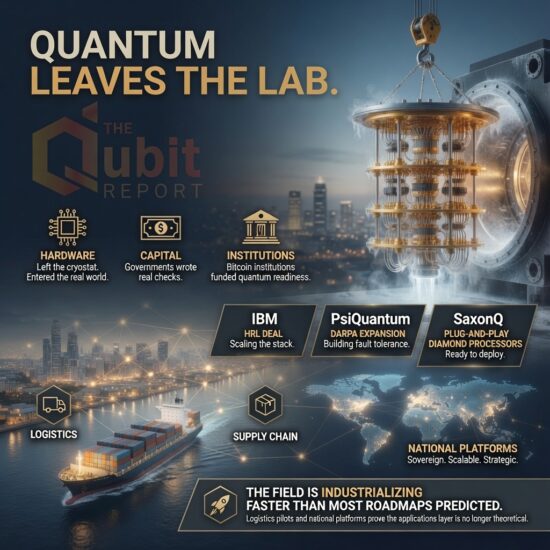
Quantum Computing Weekly Round-Up hits differently this week. The field stopped whispering about utility-scale machines and started signing nine-figure deals, plugging diamond processors into ordinary wall outlets, and forcing Bitcoin heavyweights to open their wallets for quantum defense. Hardware teams shipped systems which ignore the fridge, governments threw real money at national platforms, and the post-quantum clock got louder than ever. Miss any of these and you will feel the FOMO hard.
Mega Deals Change the Map
IBM dropped the biggest shockwave by signing a definitive agreement to acquire HRL Laboratories, the Boeing-GM joint venture long known for silicon-spin qubits and quantum sensing. The move folds HRL’s materials, cryogenics, and interconnect expertise straight into IBM’s superconducting roadmap toward Starling in 2029 and Blue Jay in the 2030s.
PsiQuantum locked in its largest U.S. government contract yet with a $125 million DARPA agreement under the Quantum Benchmarking Initiative. Stage C validation now covers hardware, software, and full-system testing at the company’s California and Chicago sites.
D-Wave will ring the Nasdaq opening bell on July 27 to mark its dual-platform listing debut, a public-market flex few pure-play quantum names have managed.
Hitachi joined the silicon party by launching a NEDO-backed project with Intel and AIST to industrialize 100-qubit and later 1,000-qubit silicon quantum computers using Intel’s 18A process, targeting cloud availability by 2027.
Hardware Actually Leaves the Lab
German startup SaxonQ started taking orders for the SXQ128 and SXQ512, the first diamond NV-center systems to clear 10 qubits while running at room temperature in a standard server rack on ordinary power. Proprietary sulfur co-implantation pushed NV yield above 85 percent and single-qubit fidelity to 99.92 percent. No dilution fridge, no vacuum, no clean-room babysitting.
OptQC and AIST powered up MoQuren, Japan’s first commercial optical quantum computer, inside AIST’s G-QuAT center as part of the ABCI-Q hybrid infrastructure. Room-temperature optics just became a practical research tool.
EuroHPC JU opened the tender for MeluXina-Q in Luxembourg, a silicon spin-qubit machine starting at 10 qubits and scaling past 80, co-funded at €11.95 million and tightly coupled to the MeluXina supercomputer.
Infleqtion locked in 2027 delivery of its Sqale fault-tolerant neutral-atom system with more than 50 logical qubits to the Illinois Quantum and Microelectronics Park, complete with NVIDIA NVQLink.
Governments Writing the Checks
Israel’s Innovation Authority committed $32.9 million for a national multi-modality quantum R&D infrastructure open to industry consortia, demanding at least three different qubit approaches under one roof.
Ireland published its Quantum 2030 Implementation Plan aimed at making the country a serious European player by the end of the decade, with explicit focus on talent, research translation, and enterprise use cases.
The European Commission opened a public consultation on the future of quantum Joint Undertakings under Horizon Europe 2028–2034, and the Quantum Flagship is pushing hard for a dedicated, ring-fenced Quantum Initiative.
Singapore’s Digital and Intelligence Service teamed with IBM for mission planning and logistics optimization, giving SAF engineers cloud access and joint algorithm development on combinatorial problems classical machines choke on.
Post-Quantum Crypto Gets Teeth (and Bitcoin Notices)
NEAR Protocol activated quantum-safe ML-DSA signing on mainnet, becoming one of the first layer-1 chains to ship NIST-approved post-quantum signatures in production.
BlackRock, Coinbase, Strategy, Fidelity, Galaxy and peers launched the Bitcoin Security Consortium with a $15 million three-year pledge focused first on quantum threats to Bitcoin’s elliptic-curve cryptography. Galaxy separately committed up to $5 million of its own for grants, research, and an advisory council.
DigiCert’s second annual survey showed 87 percent of organizations are planning or testing PQC, yet actual deployment across most certificates remains stuck at 7 percent. AppViewX released hybrid ML-DSA composite certificates and an AI-ready MCP Server so certificate teams can start the migration without breaking everything.
SPTel took Frost & Sullivan’s 2026 Singapore Company of the Year award for quantum-safe network services, while Australia’s Signals Directorate published practical post-quantum vendor questions so procurement teams can stop accepting vague assurances.
Applications Actually Ship
IQM and Deutsche Bahn ran a hybrid QAOA pipeline on real operational data covering 190 trips and nearly 100,000 possible cycles, producing feasible railway schedules end-to-end on existing superconducting hardware.
Telefónica and Würth used a hybrid quantum-classical approach at Würth’s Agoncillo plant to optimize packaging across more than 6,000 orders, cutting transport volume up to 7 percent and cardboard use by more than 6 percent in the logistics pilot.
Quantinuum and SoftBank published a joint white paper mapping chemistry and graph-analytics use cases onto Quantinuum’s hardware roadmap all the way to the fault-tolerant era.
QEDMA integrated its advanced error-mitigation software directly onto Quantinuum’s platform, giving users higher-fidelity results on the same hardware they already run.
Infrastructure and the Supporting Cast
JLL’s new report counted more than 240 quantum facilities across 35 countries and a $4 billion construction pipeline fueled by $70 billion in global investment, declaring quantum real estate its own emerging sector with talent density as the new location king. Zero Point Cryogenics opened its first U.S. innovation hub at IQMP in Chicago.
Interlune demonstrated 99 percent pure helium-3 production from domestic helium using cold-capture cryogenics, a direct answer to the dilution-refrigerator bottleneck.
QuantX Labs successfully commissioned the world’s first optical frequency comb in orbit, giving Australia flight heritage for quantum timing which will feed future optical atomic clocks.
BTQ’s QPerfect and the University of Strasbourg built a hardware-accurate digital twin of France’s first public neutral-atom platform, while Quside dropped a CUDA library injecting verifiable quantum entropy straight into NVIDIA GPU workflows.
Lab Moments Stick
Columbia researchers reported the first experimental evidence of a fractional topological insulator in twisted MoTe₂, a long-predicted state could host robust helical edge modes useful for error-resistant quantum information.
Northwestern engineers distributed entanglement over 24.4 kilometers of live commercial fiber carrying 800 Gbps classical traffic between Evanston and Chicago, proving the quantum internet can share existing infrastructure.
UCLA engineers observed quantum heat waves (focused phonon rays) at room temperature in boron arsenide, opening a path to precise thermal management inside future quantum and classical chips.
Bottom Line
This was the week quantum stopped treating the real world as a future problem and started buying labs, plugging into wall outlets, defending Bitcoin, and optimizing actual trains and packaging lines.
—
See the full week of articles in the Weekly Archives Pages and the Weekly Round-Ups found at The Qubit Report.
- BlackRock, Coinbase, D-Wave, DARPA, EuroHPC, Galaxy Digital, HRL Laboratories, IBM, Illinois Quantum and Microelectronics Park, Interlune, Ireland, Israel Innovation Authority, Luxembourg, NEAR Protocol, Northwestern University, PsiQuantum, Quantinuum, Quantum Computing Weekly Round-Up, SaxonQ, Singapore, SoftBank
Related Articles
The Qubit Report: October 26, 2026
Dark fiber now carries IonQ quantum key distribution between Palm Beach State College and FAU, lighting the first operational segment of Florida’s statewide quantum-safe network.
QDNL Convenes Benelux-QCI Partners to Advance EuroQCI QKD Priorities
On October 22, 2026, QDNL hosted the Benelux-QCI event in Utrecht to advance cross-border quantum key distribution under EuroQCI. Partners from the Netherlands, Belgium, Luxembourg
Quantum Computing Weekly Round-Up: Week Ending October 24, 2026
Quantinuum posted 99.9995 percent logical fidelity, a 10x jump that keeps its 2029 fault-tolerant target alive. NVIDIA ran the biggest realistic fault-tolerant simulation yet and